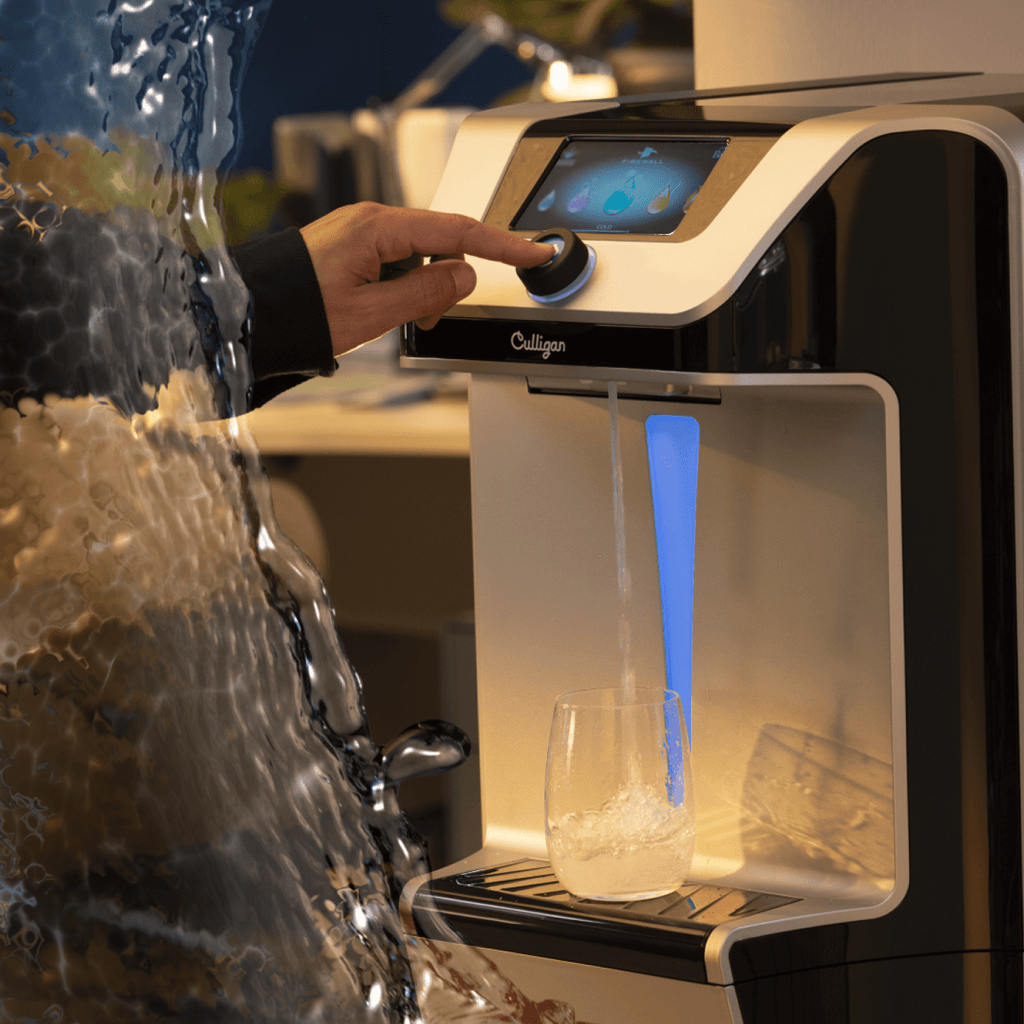
Some water coolers filter water, while others store, heat, chill, or dispense water that has already been treated elsewhere. Whether a water cooler filters the water depends on the dispenser type and its features.
Bottleless water coolers commonly include filtration because they connect directly to a building’s potable water supply. Water enters the dispenser through a dedicated water line and passes through the filtration system before it’s dispensed.
Culligan Quench bottleless water coolers use point-of-use filtration, with options such as carbon filtration and reverse osmosis available depending on the model.
How does a water cooler filter water?
A filtered bottleless water cooler treats water directly at the point of use.
The process starts with a connection to the building’s potable water supply. Water travels through a dedicated line to the dispenser and passes through the machine’s built-in filtration system.
What happens during filtration depends on the technology being used. A carbon filter and a reverse osmosis system, for example, treat incoming water differently and may be designed to reduce different substances.
After filtration, the treated water enters the dispenser. On hot and cold water dispensers, it’s then chilled or heated before it’s ready to dispense.
This entire process takes place at the point of use, which is why bottleless water coolers are also commonly called point-of-use water dispensers. Here’s a closer look at how bottleless water coolers work from start to finish.
What types of filters do water coolers use?
There isn’t one standard filter used in every water cooler. Filtration technology varies between machines, and some systems use multiple stages to treat incoming water.
Understanding the differences can help you determine which type of filtered water cooler makes sense for your workplace.
Carbon filtration.
Activated carbon is commonly used in drinking water filtration.
As water passes through the filter media, activated carbon can reduce substances that cause unwanted tastes and odors, including chlorine. Depending on the filter and its certifications, it may also be designed to reduce the presence of additional substances.
Culligan Quench offers bottleless water coolers with carbon filtration. The Culligan Quench Q4, for example, is available with advanced carbon filtration or reverse osmosis, allowing businesses to choose between filtration configurations based on their water needs.
Because carbon filters can differ in their design and performance, check the specifications of the individual system if you’re concerned about a particular substance in your water.
Reverse osmosis filtration.
Reverse osmosis, or RO, uses pressure to move water through a semipermeable membrane.
The membrane allows water to pass through while reducing the passage of specific dissolved substances. Depending on the system, reverse osmosis can remove substances that conventional carbon filtration doesn’t address in the same way.
Culligan Quench offers reverse osmosis water filters in different commercial configurations, including countertop and freestanding bottleless water dispensers.
RO isn’t automatically necessary for every workplace. The appropriate filtration technology depends on the incoming water and what you want the system to address.
Multi-stage filtration.
Some water coolers use several treatment stages rather than relying on a single filter.
For example, a system might use sediment filtration earlier in the process to address larger particles before water moves through another filtration stage. Carbon or reverse osmosis may then be used to address additional water-quality concerns.
Some systems can also include a final polishing stage or the addition of minerals following filtration.
Because the number and type of stages vary between machines, a “multi-stage” water cooler doesn’t necessarily have the same filtration capabilities as another multi-stage system. Individual product specifications provide a clearer picture of how a particular dispenser treats its water.
Do bottled water coolers filter water?
A traditional bottled water cooler works differently from a filtered bottleless system.
The water inside a replacement jug has generally been treated before it reaches the dispenser. The cooler primarily stores and dispenses that supplied water and may also heat or chill it.
That means seeing a water cooler in a workplace doesn’t automatically mean the machine itself is filtering the water.
Some bottled dispensers may include additional treatment features, so it’s still important to check the individual product if you want to know exactly how the water is handled.
Do bottleless water coolers filter tap water?
Filtered bottleless water coolers connect to a building’s potable water supply and treat incoming water directly at the point of use.
Instead of receiving water from a jug filled elsewhere, the machine receives it through a dedicated line. The water then passes through the filtration system installed with the dispenser.
Culligan Quench bottleless water coolers use this point-of-use approach, with filtration technologies varying by model.
Once filtered, water can be stored within the machine for dispensing at the temperatures supported by that particular system. On models with a hot-water option, here’s how the dispenser heats water after filtration.
This setup also means there are no large replacement water jugs to order, store, lift, or change as part of the water cooler’s regular operation.
What can a water cooler filter reduce?
What a water cooler can reduce depends on the filtration technology inside it.
Depending on the filter and its certified performance, a system may be designed to reduce substances such as sediment or chlorine taste and odour. Certain systems may also reduce lead, total dissolved solids, or other specified substances.
That doesn’t mean every filtered water cooler reduces everything on that list.
Carbon and reverse osmosis systems work differently, and filters within those categories can also have different performance specifications. A water cooler should only be expected to reduce substances that its particular filtration system is designed and certified to address.
If you’re concerned about a specific substance in your building’s water, review the performance specifications and certifications for the individual filtration system before choosing a dispenser. The filter is only part of the picture, though. Cleaning and maintenance also affect whether water from a water cooler is safe to drink.
Is UV technology the same as water filtration?
No. UV technology and water filtration are different treatment methods.
A filter uses media or a membrane to capture or separate certain substances as water passes through it. Activated carbon and reverse osmosis are examples of filtration technologies.
UV technology uses ultraviolet light as part of the water-treatment or sanitization process. It doesn’t function like a carbon filter or RO membrane and shouldn’t be treated as a replacement for filtration.
Some water dispensers combine both technologies. The Culligan Quench Q4, for example, pairs its available carbon or reverse osmosis filtration with LED UV-C technology.
When comparing water coolers, look at filtration and additional water-treatment technologies separately to understand what each part of the system does.
How often do water cooler filters need to be changed?
Water cooler filters need to be replaced periodically, but there isn’t one replacement schedule that applies to every machine. Like how often you should clean a water cooler, it depends on the system and how it’s used.
Filter type and water conditions can affect how frequently replacement is necessary. Usage matters as well, since a dispenser serving a busy workplace may process considerably more water than one used by a small team.
The manufacturer’s requirements for the individual filter should determine the appropriate replacement schedule.
For Culligan Quench bottleless water cooler customers, applicable filter changes are handled through ongoing service and preventive maintenance. This helps maintain the filtration system in accordance with the equipment’s requirements, and regular service also plays a role in how long a water cooler lasts.
How do you know if a water cooler has a filter?
Start by checking the product specifications.
A manufacturer should identify whether a water dispenser includes filtration and what type of technology it uses. Look for information about carbon filters, reverse osmosis, filter cartridges, or other treatment stages.
If the manufacturer provides certifications or contaminant-reduction information, those specifications can also help you understand what the filtration system is designed to do.
For a bottleless dispenser, don’t assume that knowing it connects to a water line tells you everything about its filtration. Two point-of-use water coolers can use different filtration technologies and have very different capabilities.
Culligan Quench lists filtration information with its individual water cooler models so businesses can compare available options.
FAQ
Does a water dispenser filter tap water?
Some water dispensers do.
Filtered bottleless water dispensers connect to a potable water supply and treat incoming water at the point of use. Other types of dispensers may store and dispense water that was treated elsewhere.
Check the specifications of the individual machine to determine whether it includes filtration.
Do all bottleless water coolers have filters?
Bottleless water coolers are commonly designed to use point-of-use filtration, but features can vary between manufacturers and models.
Culligan Quench bottleless water coolers use filtration systems to treat incoming potable water, with the filtration technology varying between machines.
If you’re comparing bottleless systems, look beyond whether the machine “has a filter” and check what type of filtration it actually provides.
Is reverse osmosis better than a carbon filter?
Neither filtration method is automatically better for every situation.
Carbon filtration and reverse osmosis work differently and can address different water-quality needs. Carbon filtration is commonly used to address substances associated with taste and odour, while reverse osmosis can reduce a broader range of dissolved substances depending on the system.
The right option depends on the incoming water and what you want the filtration system to accomplish.
Does filtered water still contain minerals?
It depends on how the water is filtered.
Different filtration technologies affect dissolved minerals in different ways. Carbon filtration generally works differently from reverse osmosis, which can reduce a broader range of dissolved substances.
Some water systems also add minerals following filtration. Because treatment processes vary, check the specifications of the individual system if mineral content is important to you.
Can a water cooler filter remove lead?
Some water filtration systems are designed and certified to reduce lead, but this isn’t a capability you should assume every water cooler filter has.
If lead reduction is a priority, look for a filtration system with specific performance information or certification supporting that claim.
Culligan Quench offers applicable filtration systems with documented lead-reduction capabilities. The individual product information should be reviewed to determine whether a particular water cooler or filter meets your requirements.
Find the right filtered water cooler for your workplace.
A filtered water cooler can treat incoming water right where it’s dispensed, but choosing the right system starts with understanding what type of filtration your workplace needs.
Culligan Quench offers bottleless water coolers for businesses across Canada, with various filtration configurations, including carbon and reverse osmosis. Available systems also vary in capacity, size, water temperatures, and dispensing features, including touchless dispensing.
Explore Culligan Quench Water Coolers or use the Product Finder to compare available systems. A Culligan Quench Water Expert can also help determine which filtration option makes sense for your workplace and incoming water.
Recommended products
Culligan Quench has an advanced suite of point-of-use systems that are designed to meet the needs of workplaces of all shapes and sizes. Here are some products we recommend for your business.
570 Bottleless Water Cooler
Vivreau® Freestanding Main Bottler
 High
 Hot
 Cold
 Ambient
 Extra Hot
 Sparkling

Q10 Bottleless Water Cooler With Sparkling Water
Includes Firewall® UV Protection
High
Hot
Cold
Ambient
Extra Hot
Sparkling
Top pick

Q12 Touchless Bottleless Water Cooler
Available with quenchWATER+ electrolyte water
 Commercial
Hot
Cold
Ambient
Extra Hot
Sparkling
Top pick

Q14 Bottleless Water Cooler
Available with quenchWATER+ electrolyte water
Commercial
Hot
Cold
Ambient
Extra Hot
Sparkling
Top pick

Q3 Bottleless Water Cooler
Available with quenchWATER+ electrolyte water
 Standard
Hot
Cold
Ambient
Extra Hot
Sparkling

Q4 Touchless Bottleless Water Cooler
Available with quenchWATER+ electrolyte water
Standard
Hot
Cold
Ambient
Extra Hot
Sparkling

Q5 Bottleless Water Cooler
Available with quenchWATER+ electrolyte water
High
Hot
Cold
Ambient
Extra Hot
Sparkling

Q8 Touchless Bottleless Water Cooler
Available with quenchWATER+ electrolyte water
High
Hot
Cold
Ambient
Extra Hot
Sparkling
Q9 Bottleless Water Cooler
Includes Firewall® UV protection
High
Hot
Cold
Ambient
Extra Hot
Sparkling

Replacement Filter for Bottleless Water Cooler
Model P02800 1 micron lead reduction block filter
High
Hot
Cold
Ambient
Extra Hot
Sparkling
