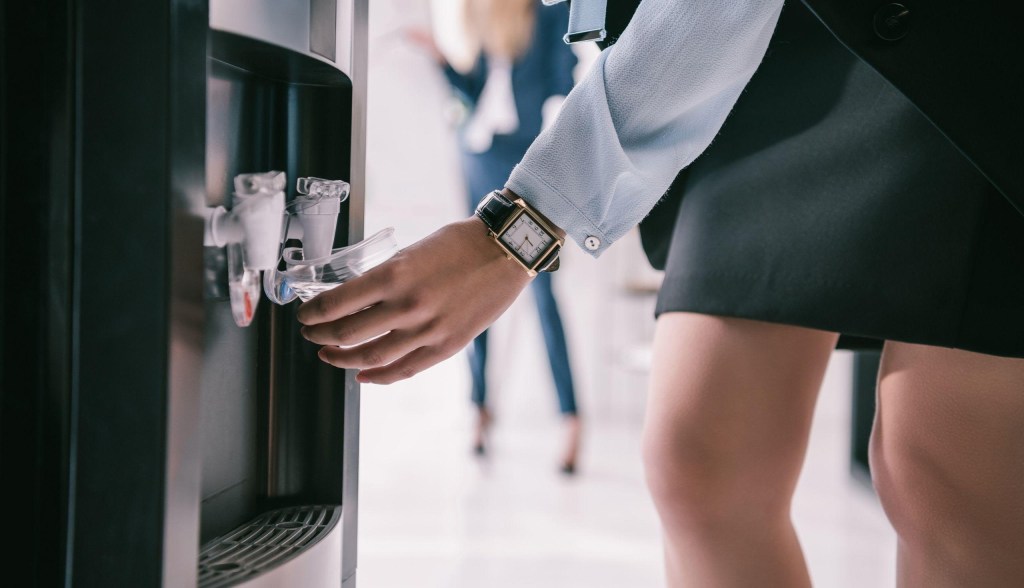
Water coolers provide easy access to drinking water by storing or receiving water, bringing it to the right temperature, and dispensing it when needed. Depending on the system, the water may also be filtered before it reaches your cup.
The exact process depends on the type of water cooler. Traditional bottled coolers use a replaceable jug, while bottleless water coolers connect directly to a building’s water supply.
What is a water cooler?
A water cooler is a dispenser that provides convenient access to drinking water. While the name might suggest these machines only chill water, many modern water coolers can also provide hot or ambient water.
Water coolers come in several configurations. Freestanding models are common in offices and other shared spaces, while countertop water dispensers offer similar functionality in a smaller footprint.
The water source can vary, too. Some coolers rely on large water bottles that need to be replaced when empty. Bottleless water coolers connect directly to an existing water line and can filter the incoming water at the point of use.
How does a water cooler work?
Most water coolers follow a fairly simple process. Water enters the machine, moves through any applicable filtration system, and is prepared for dispensing.
Here’s a closer look at what happens inside.
Water enters the cooler.
Every water cooler needs a water source. Where that water comes from depends on whether the machine is bottled or bottleless.
A bottled cooler draws water from a jug installed on the machine. As people dispense water, more moves from the bottle into the cooler until the bottle is empty and needs to be replaced.
A bottleless water cooler, sometimes called a point-of-use water cooler, connects directly to the building’s existing potable water supply. Water travels through a small water line into the dispenser as needed.
The water may be filtered.
Filtration depends on the type of water cooler. Many bottleless systems filter incoming tap water before it is stored or dispensed.
The filtration process itself varies by machine. Carbon filtration can help reduce chlorine and substances that affect the taste or odour of water. Some systems use multiple filtration stages or reverse osmosis for more advanced water treatment.
Culligan Quench offers bottleless water coolers with different filtration options, allowing businesses to choose a system suited to their workplace and incoming water supply.
Water moves into the reservoir.
Once water enters the cooler and passes through any applicable filtration stages, it can move into an internal reservoir.
The configuration depends on the machine. A hot and cold water dispenser may use separate reservoirs so the system can maintain water at different temperatures and have it ready when someone needs it.
Reservoir capacity also varies between models. A machine designed for a smaller office will have different capacity requirements than one intended for a busy workplace with frequent daily use.
Water is cooled.
For a water cooler to provide chilled water, the machine needs a way to remove heat from the water.
Many powered water coolers use a refrigeration system with a compressor to cool water inside the cold reservoir. A thermostat helps regulate the temperature so the machine can keep a supply of cold water ready for use.
When someone fills a cup or bottle, new water enters the system to replace what was dispensed. That water is then cooled for the next user.
Water is dispensed.
When you press the cold-water button or activate another control, water moves from the appropriate reservoir to the dispensing outlet.
The way you activate the dispenser varies by model. Some water coolers use traditional buttons or paddles, while others offer touchless controls.
After water is dispensed, the system replenishes its supply and prepares the incoming water for the next use.
How do water coolers make hot water?
Water coolers that offer a hot and cold water option generally use a separate reservoir equipped with a heating element.
Water enters the hot side of the system, where the heating element brings it to the machine’s designated temperature. A thermostat helps regulate the temperature so hot water can remain ready to dispense.
Keeping the hot and cold water supplies separate allows a single machine to maintain two different temperatures simultaneously.
Bottleless vs. bottled water coolers.
The main difference between bottled and bottleless water coolers is how water gets into the machine.
A bottled cooler relies on a replaceable jug. Once the bottle is empty, someone has to remove it and install a new one. Workplaces that use bottled systems also need a place to store their replacement bottles.
A bottleless water cooler connects directly to the building’s potable water supply. Water enters through a dedicated line, passes through the applicable filtration system, and becomes available for dispensing without a jug that needs replacing.
Both types of water coolers can offer temperature-controlled water depending on the model.
Do water coolers filter the water?
Some water coolers filter water, though filtration isn’t standard on every type of dispenser.
Bottleless filtered water coolers treat water at the point of use. Incoming water travels from the building’s supply through the machine’s filtration system before reaching the dispensing stage.
The type of filtration depends on the system. Culligan Quench bottleless water coolers are available with filtration technologies such as carbon filtration and reverse osmosis.
Reverse osmosis uses a semipermeable membrane as part of the filtration process. This type of system can reduce total dissolved solids and specific contaminants based on the filter’s capabilities.
How water coolers support workplace hydration.
Having a water cooler in a shared space gives employees convenient access to drinking water throughout the workday. The right system depends on how many people will use it and what features make sense for the space.
A workplace that regularly serves tea or other hot drinks may benefit from a hot-and-cold dispenser. An office with limited floor space may find that a countertop model is a better fit.
Bottleless systems can also simplify the way workplaces manage their drinking water. Because the machine connects to the existing water supply, there are no large water jugs to store or replace.
Culligan Quench offers workplace water coolers in various capacities and configurations, allowing you to match the dispenser to how your workplace actually uses it.
FAQ
Do water coolers need electricity?
Water coolers that actively heat or chill water generally require electricity. Electricity may also power features such as electronic controls or UV-C technology on applicable models.
Does a bottleless water cooler need a water line?
Yes. A bottleless water cooler connects to a building’s existing potable water supply through a water line.
This connection allows the machine to receive water as needed instead of relying on a replaceable bottle. The incoming water passes through the dispenser’s filtration system before being prepared for use.
How long does it take a water cooler to get cold?
Cooling time varies between water coolers. The size of the reservoir and the machine’s cooling capacity can both affect how quickly water reaches its intended temperature.
After installation or a period without power, the cooler may need some time for its cold-water supply to be ready. Check the manufacturer’s instructions for information specific to your model.
Do water coolers need to be cleaned?
Yes. Water coolers require routine cleaning and maintenance to keep the dispenser clean and operating properly.
The appropriate cleaning process depends on the machine. Accessible areas such as the dispensing point and drip tray may require regular attention, while internal maintenance should follow the manufacturer’s service recommendations.
Find the right water cooler for your workplace.
Understanding how water coolers work can make it easier to decide what your workplace actually needs from one.
Consider how many people will use the dispenser and how much space is available. From there, you can consider features such as filtration, water temperature, and dispensing options to find a system that fits how your workplace operates.
Culligan Quench offers bottleless water coolers for workplaces across Canada, including countertop and freestanding models with a range of filtration and dispensing options.
Recommended products
Culligan Quench has an advanced suite of point-of-use systems that are designed to meet the needs of workplaces of all shapes and sizes. Here are some products we recommend for your business.
570 Bottleless Water Cooler
Vivreau® Freestanding Main Bottler
 High
 Hot
 Cold
 Ambient
 Extra Hot
 Sparkling

Q3 Bottleless Water Cooler
Available with quenchWATER+ electrolyte water
 Standard
Hot
Cold
Ambient
Extra Hot
Sparkling

Q5 Bottleless Water Cooler
Available with quenchWATER+ electrolyte water
High
Hot
Cold
Ambient
Extra Hot
Sparkling

Q4 Touchless Bottleless Water Cooler
Available with quenchWATER+ electrolyte water
Standard
Hot
Cold
Ambient
Extra Hot
Sparkling

Q8 Touchless Bottleless Water Cooler
Available with quenchWATER+ electrolyte water
High
Hot
Cold
Ambient
Extra Hot
Sparkling

Q9 Bottleless Water Cooler
Includes Firewall® UV protection
High
Hot
Cold
Ambient
Extra Hot
Sparkling

Q14 Bottleless Water Cooler
Available with quenchWATER+ electrolyte water
 Commercial
Hot
Cold
Ambient
Extra Hot
Sparkling
Top pick
