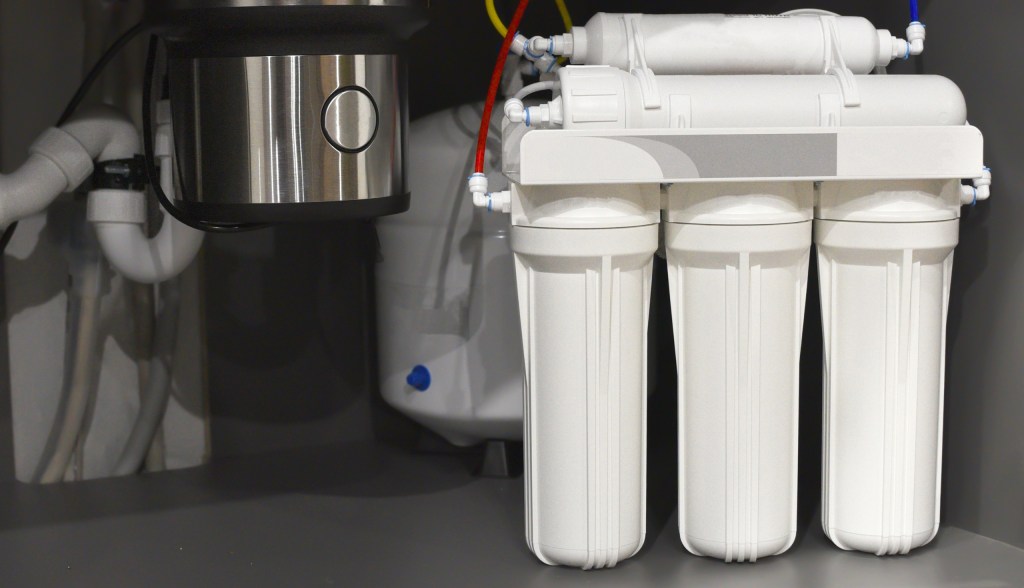
Some water coolers have built-in filtration systems, while others dispense water from their existing source. Whether a water cooler filters its water largely depends on the type of dispenser you’re using.
Bottleless water coolers are commonly designed to filter water at the point of use. They connect to a building’s water supply and treat the incoming water before it’s dispensed. Traditional bottled coolers work differently, since the water arrives at the dispenser already bottled.
Understanding that difference can help you decide what type of water cooler makes sense for your workplace.
How do water cooler filters work?
In a filtered water cooler, water passes through one or more filters before reaching the dispensing point. Each filtration stage has a specific role, and the setup varies by machine.
Some systems are primarily designed to improve the taste and odor of municipal water. Others provide more advanced filtration when additional water treatment is needed.
Sediment filtration
Sediment filtration targets larger particles suspended in the incoming water. It can also serve as an early stage in a multi-stage filtration system, preparing the water before it moves through additional filters.
The exact filtration sequence depends on the water cooler and the installed filtration system.
Carbon filtration
Activated carbon is widely used in drinking water filtration. As water passes through the filter, the carbon can reduce chlorine and compounds that contribute to unwanted tastes or odors.
For workplaces with an otherwise suitable municipal water supply, carbon filtration may be an option to improve the drinking experience without requiring a more intensive treatment process.
Reverse osmosis
Reverse osmosis, or RO, provides another level of water treatment. An RO system uses a semipermeable membrane as part of a multi-stage filtration process to reduce total dissolved solids and certain contaminants in the incoming water.
Culligan Quench offers workplace water dispensers with reverse osmosis filtration for locations where this type of treatment is appropriate.
Do bottled water coolers have filters?
A traditional bottled water cooler typically receives water that has been treated before it reaches the dispenser. The cooler’s main job is to store and dispense that supplied water rather than filter water coming directly from the tap.
That means many bottled coolers don’t need an internal filtration system. The exact design varies, though, so it’s always worth checking the specifications of a particular dispenser.
This is also an important distinction when comparing bottled and bottleless systems. With bottled water, treatment occurs before the water reaches the bottle.
Do bottleless water coolers have filters?
Filtration is a key feature of many bottleless water coolers.
Instead of receiving water from a jug, a bottleless dispenser connects to the building’s potable water supply. The incoming water travels through the unit’s filtration system before it’s available to drink.
What happens during that filtration stage depends on the machine. One workplace may use a system with carbon filtration, while another may require reverse osmosis based on its incoming water and filtration needs.
This point-of-use approach also means businesses don’t have to rely on replacement water jugs to keep the cooler supplied.
What do water cooler filters remove?
There isn’t one answer that applies to every water cooler filter. What a filter can reduce depends on its design, media, and certifications.
A sediment filter, for example, is designed to address particles. Activated carbon can reduce chlorine and substances that contribute to unpleasant tastes and odors.
Reverse osmosis systems are designed to address a broader range of dissolved substances. The RO membrane can reduce total dissolved solids (TDS) and specific contaminants based on the system’s capabilities.
This is why it’s important to look beyond the word “filtered” when choosing a water cooler. The better question is what type of filtration the system uses and what that particular filter is designed to reduce.
If water quality is an important consideration for your workplace, a Culligan Quench Water Expert can help determine which filtration approach is appropriate for your location.
How often do water cooler filters need to be replaced?
Water cooler filters don’t last indefinitely. Over time, they need to be replaced so the filtration system can continue performing as intended.
There isn’t a universal replacement schedule for every water cooler. Filter type and water usage can affect how often replacement is needed. The quality of the incoming water can also play a role.
For that reason, filter changes should follow the service schedule for the specific system rather than a generic timeline found online.
Regular filter replacement is also different from cleaning the dispenser itself. Both are part of maintaining a filtered water cooler, but they address different parts of the system.
Benefits of a filtered water cooler for your workplace.
A filtered water cooler combines water treatment and dispensing at the point where employees actually drink their water.
For many workplaces, one of the most noticeable benefits is taste. Filtration that reduces chlorine and other substances that affect taste or odor can make the existing water supply more appealing to drink.
Bottleless filtered systems can also make workplace hydration easier to manage. Since the dispenser draws from the building’s water line, there’s no need to keep a supply of heavy replacement water jugs on hand.
Businesses can also select filtration based on their actual water needs. A workplace that benefits from carbon filtration doesn’t necessarily need the same system as a location where reverse osmosis is appropriate.
That flexibility makes the filtration system itself an important consideration when choosing a workplace water cooler.
FAQ.
Are all water cooler filters the same?
No. Water cooler filters use different technologies and are designed for different purposes.
A carbon filter works differently from a reverse osmosis membrane, for example. When comparing filtered water coolers, look at the filtration technology and the system’s specific reduction capabilities rather than assuming all filters provide the same treatment.
Can you use a water cooler without a filter?
Yes, depending on the type of water cooler.
Many bottled water coolers operate without an internal filtration system because they dispense water supplied from a bottle. A bottleless filtered dispenser uses filters as part of its point-of-use treatment process.
Do water cooler filters need maintenance?
Yes. Replaceable filters need to be changed according to the filtration system’s requirements.
Other parts of the water cooler also require appropriate cleaning and maintenance. Following the recommended service schedule helps keep the entire dispenser operating as intended.
Is reverse osmosis the same as a water filter?
Reverse osmosis is a specific method of water filtration. It uses pressure to move water through a semipermeable membrane that can reduce dissolved solids and certain contaminants.
RO is often a single stage within a broader filtration system rather than a standalone filter.
Find the right filtration for your workplace.
Choosing a water cooler isn’t just about deciding where you want the machine to sit. The quality of the incoming water and the type of filtration you need matter, too.
Culligan Quench offers bottleless water coolers with filtration options for different workplace environments and water-quality needs. Available systems include carbon filtration and reverse osmosis, with dispenser options suited to workplaces of all sizes.
Recommended products
Culligan Quench has an advanced suite of point-of-use systems that are designed to meet the needs of workplaces of all shapes and sizes. Here are some products we recommend for your business.
250 Deionizing Water Filter System
 High
 Hot
 Cold
 Ambient
 Sparkling
 Extra Hot

50/52 Under-Sink Water Filtration System
 Standard
Hot
Cold
Ambient
Sparkling
Extra Hot

Replacement Filter for Bottleless Water Cooler
Model P02800 1 micron lead reduction block filter
High
Hot
Cold
Ambient
Extra Hot
Sparkling
